In short.
- A neighbour damaged by building works falls outside the regime of the LOE: article 17 of Law 38/1999 protects the owners and purchasers of the building itself for damage to that building. The adjoining owner claims through the non-contractual route of the Spanish Civil Code: one's own fault (art. 1902), that of one's employees (art. 1903) and the owner's liability cases (arts. 1907-1909).
- The developer, the contractor, subcontractors and the site management team may all be sued at the same time; who ultimately pays depends on where the failure lay (design, execution, supervision). Under the common Civil Code, the action becomes time-barred one year after the injured party became aware of the damage (art. 1968.2); under the Civil Code of Catalonia, after three (art. 121-21.d).
- Within the policy, damage to adjoining property is usually a section with its own sub-limit inside the liability cover; the injured party may bring a claim directly against the insurer (art. 76 of the Insurance Contract Act), always within the limits and sub-limits of the policy.
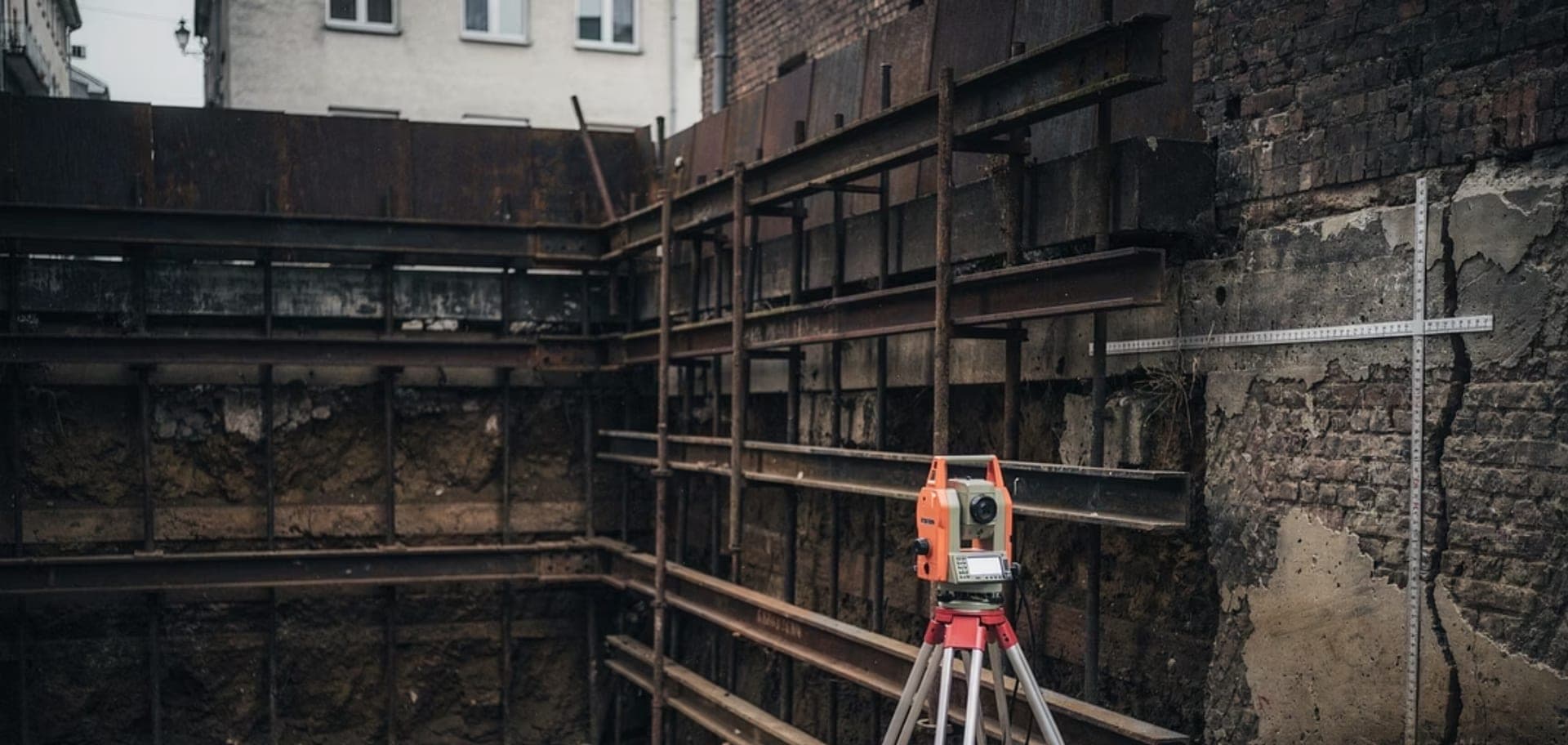
Damage to adjoining property during building works rarely arrives in a single letter. Digging out a basement causes settlement in the building next door, and the claim reaches the developer, the main contractor, the excavation firm and the professionals who signed off as site management.
For those running a development company or a contractor, the useful question is not "can they claim against us?" but on what legal basis the claim is brought and which policy answers for it.
In the United Kingdom this ground would be governed by the Party Wall etc. Act 1996. In Spain there is no equivalent statute: the relationship between adjoining buildings is governed by the rules on medianería (party walls) and by the general law of non-contractual liability in the Civil Code.
Why does the neighbour not claim under the LOE?
Article 17.1 of Law 38/1999 on Building Regulation (Ley de Ordenación de la Edificación, LOE) makes the parties involved in a building project liable "to the owners and subsequent purchasers" for "material damage caused to the building", within periods of ten, three and one year counted from handover of the works without reservations or from the remedying of those reservations (as recorded in the certificate of handover of the works). The neighbour is neither owner nor purchaser of the building under construction, and their damage is not to that building but to the one next door.
The practical consequence: as a general rule, the ten-year structural defects insurance (seguro decenal) does not answer for damage to the neighbour. The guarantee under article 19.1.c of the LOE covers the building constructed, and article 19.9.b expressly excludes from the guarantees "damage caused to buildings contiguous or adjacent to the building", "unless otherwise agreed". It is not an absolute "no", but it is the starting point. Ten-year structural defects and contractors' all risks insurance and ten-year structural liability are explained on their own pages.
What remains open to the adjoining owner is the general route: the non-contractual liability of the Civil Code, which arises from damage caused to someone who is not party to any contract.
The rules the courts apply to damage to adjoining property
Article 1902 of the Civil Code is the general rule: whoever, by act or omission, causes damage to another through fault or negligence is obliged to make it good. This is the case of the contractor that excavates without due precautions.
Article 1903 extends liability to the owners or managers of a business for the harm caused by their employees "in the service of the branches in which they were employed". The company answers for the operator at the controls of the excavator.
Articles 1907 and 1908: the owner's liability
Article 1907 makes the owner of a building liable for damage resulting from its collapse where this occurs through failure to carry out necessary repairs. Article 1908 sets out a closed list of cases: explosion of machinery not maintained with due diligence and ignition of explosive substances not stored in a safe place, excessive and harmful fumes, trees falling in places of passage, and emissions from sewers and deposits of infectious material.
Except for the explosives case, they fit poorly with works in progress: damage to adjoining property does not usually stem from a neglected building or from those specific cases, but from an activity (excavating, demolishing, piling). That is why article 1902 is the usual route.
Article 1909: where the damage stems from a construction defect
Under article 1909, if the damage referred to in the two preceding articles results from a construction defect, the third party who suffers it "may only claim against the architect or, where applicable, against the builder, within the legal period". Its scope is a matter of interpretation by the courts and does not lend itself to a fixed rule.
Party walls and works on the neighbouring property (arts. 569, 579 and 590)
- Article 569. If it is indispensable for the works to carry materials across the neighbouring property or to erect scaffolding on it, the owner must allow it, receiving compensation for the harm caused to them.
- Article 579. Before resting a structure on the party wall, the consent of the other co-owners of the wall must be obtained; failing that, the conditions are set by experts.
- Article 590. Certain constructions near another's wall or a party wall require the regulatory distances to be observed and protective works to be carried out or, in the absence of regulations, the precautions set by an expert report.
In Catalonia, party walls and neighbourly relations have their own rules in the Civil Code of Catalonia (Código civil de Cataluña).
Who is liable: the developer, the contractor or the site management team?
In practice, the neighbour tends to sue everyone involved and leaves the proceedings to establish the cause.
Contractor. Under article 11 of the LOE, the contractor carries out the works in accordance with the design and the instructions of the site management team (dirección facultativa). It is the first target when the damage arises from execution: excavation, shoring, machinery. It also answers for its employees (art. 1903).
Subcontractor. The excavation, piling or demolition firm answers for its own fault. The main contractor may be caught by its choice or supervision of the subcontractor, as explained in the article on contractors' vicarious liability.
Site management team. The site architect directs the technical aspects in accordance with the design (art. 12 LOE) and the construction manager is responsible for the physical execution and its supervision (art. 13 LOE). Towards the neighbour, they are liable if the damage stems from a design error, a deficient calculation of the retaining structures or a lack of supervision. Their full regime is set out in liability of the architect and the site management team.
Developer. Article 9 of the LOE defines the developer as the party who decides on, promotes, schedules and finances the works. The developer usually appears among the defendants, but being sued is not the same as being held liable: that will depend on what is proven.
Several defendants at once
Where the cause cannot be attributed to a single party, the courts have on occasion held several parties jointly and severally liable, so-called "improper" joint and several liability, which arises from the judgment and not from statute. It should not be confused with the statutory joint and several liability of article 17.3 of the LOE, which operates towards owners and purchasers, not towards neighbours.
| Party | Usual basis of liability | When it is usually liable | Policy that responds |
|---|---|---|---|
| Contractor | Arts. 1902 and 1903 Civil Code | Execution failures: excavation, shoring, machinery | Contractor's general / public liability |
| Subcontractor | Art. 1902 Civil Code | Damage caused by its own activity | Subcontractor's liability policy |
| Site management team | Art. 1902 Civil Code (and 1909 only if the damage falls within arts. 1907-1908) | Design, calculation or supervision error | Professional indemnity of the technical professional |
| Developer | Art. 1902 Civil Code | Depending on its involvement and what is proven | Developer's liability policy |
Are you about to dig out a basement or work on a party wall? Let us review the adjoining-property sub-limit on your policy before work begins.
Excavation, vibration and party walls: the three typical claims
Excavation and undermining. Digging out basements or car parks alters the ground on which the neighbouring foundations rest: differential settlement, cracks in façades and partitions and, in serious cases, loss of support. This is where retaining structures and shoring matter most.
Vibration. Demolition, pile driving and heavy machinery transmit vibration to nearby buildings. The difficulty lies in proving the causal link: a crack may be due to the vibration, to the age of the building or to earlier settlement.
Work on the party wall. Resting the new structure on it, cutting chases or demolishing the building that leaned on it are delicate operations: an error in the temporary propping or in obtaining prior consent (art. 579) turns ordinary works into a claim.
We provide no figures on frequency or average cost: we have not found a public source to support them.
How the damage is proven: the prior condition of adjoining buildings
Article 1902 requires fault and a causal link. If the works cannot show what condition the neighbouring building was in before they began, every crack tends to be attributed to them, including those that already existed. For this reason, certain practices have become established in the sector, although they are not a general legal obligation:
- Prior condition survey of the adjoining buildings, with dated photographs.
- Notarial certificate of attendance (acta notarial de presencia) recording that condition.
- Tell-tales or crack monitors on existing cracks, to measure whether they develop.
- Topographic monitoring of settlement during excavation.
When a neighbour reports cracks, that documentation makes it possible to distinguish what the works caused from what was already there. Municipal by-laws and the building licence may impose additional requirements.
How the insurance responds: cover for damage to adjoining property
In the contractor's liability policy, damage to adjoining property from excavation and vibration usually appears as a specific adjoining-property damage section, with its own sub-limit and deductible, according to the terms of each policy. In this type of claim, the general limit rarely decides the outcome: the sub-limit does. How these figures combine is explained in the article on sub-limits and deductibles.
That section forms part of liability insurance for businesses: damage to adjoining property is damage to third parties, not to the works. The boundary between contractors' all risks and liability on site is dealt with separately.
Three further issues shape the claim:
- Several policies at once. The contractor, subcontractors, technical professionals and developer each have their own; who is a third party to whom is analysed in the article on cross liability.
- Direct action. The neighbour may sue the insurer directly (art. 76 of the Insurance Contract Act), with the nuances explained in the frequently asked questions.
- Public works. If the works are commissioned by a public authority, the neighbour's claim against the contractor has its own particular features, explained in the article on public works.
Where several policies coexist on the same site, aligning them avoids gaps. Let us discuss your construction liability programme.
Time limits for claiming: one year or three, depending on the applicable law
- Common Civil Code. Article 1968.2 sets one year for the action under article 1902, counted "from when the injured party became aware of it".
- Civil Code of Catalonia. Article 121-21.d sets three years for non-contractual liability, and article 121-23 places the start of the period at the point when the claimant knows, or could reasonably know, the circumstances on which it is based and whom to claim against. This is the relevant rule for works in Barcelona and the rest of Catalonia.
For damage that develops over time, such as cracks that continue to open months after excavation, the start of the period is disputed and does not lend itself to a fixed rule. For the company facing the claim, the prudent course is to notify its insurer as soon as it becomes aware of the incident, without waiting for proceedings to be issued.
The role of an independent broker
As an independent brokerage registered with the Spanish DGSFP under reference J0140, we act on the client's mandate, not the insurer's. On a project with adjoining-property exposure, we check that the adjoining-property sub-limit suits the type of works (basement excavation, party walls, demolition), we verify that the liability cover of subcontractors and technical professionals is in force and responds to such damage, we align the policies where several companies are involved and we support you through the claim. This is how we apply it in insurance for construction companies.
We will analyse, without obligation, how your liability programme would respond to damage to adjoining property: sub-limits, deductibles, subcontractors and technical management. Talk to us.
Frequently asked questions
Does ten-year structural defects insurance cover damage to the neighbouring building? As a general rule, no. The LOE (arts. 17 and 19) protects the building constructed for the benefit of owners and purchasers, and article 19.9.b excludes from the guarantees damage to "buildings contiguous or adjacent to the building", unless otherwise agreed. The neighbour claims through the non-contractual route and the liability policy responds, according to its terms.
Can the neighbour sue the site management team as well as the contractor? Yes, if they attribute the damage to a design error or a lack of supervision (arts. 12 and 13 of the LOE; art. 1902 of the Civil Code and, where applicable, art. 1909). Who ultimately pays is decided according to the cause that is proven.
Is the neighbour obliged to allow scaffolding on their property? If it is indispensable for the works, yes, but with the right to be compensated for the harm caused to them, under article 569 of the Civil Code.
When does the time limit start to run if cracks keep appearing? The rule is one year from when the injured party became aware of the damage (art. 1968.2 of the Civil Code) and three years in Catalonia (art. 121-21.d of the Civil Code of Catalonia). For damage that develops over time, the start of the period is disputed: it is advisable not to wait.
Can the neighbour claim directly against our insurer? Yes. Article 76 of the Insurance Contract Act grants a direct action, and the insurer may not raise against the neighbour the defences it has against its insured; it may, however, raise the injured party's sole fault and any personal defences it has against them, and compensation remains within the limits and sub-limits of the policy. The insurer may seek recovery from the insured if the damage was caused by the insured's wilful misconduct.
Sources and legislation
- Spanish Civil Code (Código Civil), articles 569, 579, 590, 1902, 1903, 1907, 1908, 1909 and 1968.2 (consolidated text, consulted 12-10-2026).
- Law 38/1999 on Building Regulation (Ley de Ordenación de la Edificación), articles 9, 11, 12, 13, 17 and 19 (including 19.9.b).
- Law 29/2002, first law of the Civil Code of Catalonia (Código civil de Cataluña), articles 121-21.d and 121-23.
- Law 50/1980 on Insurance Contracts (Ley de Contrato de Seguro), article 76.
Who is liable in each case is decided by the court in light of the cause of the damage and the contracts between the parties involved; this guide describes the legal framework and does not resolve specific cases. Cover for damage to adjoining property, its sub-limit and its exclusions depend on the terms and conditions of each policy; neither cover nor cost is guaranteed. The applicable law may be the common Civil Code or the Civil Code of Catalonia, and municipal by-laws may impose additional requirements on the works. This information is for guidance only and does not constitute legal or binding advice. New Brokers Correduría de Seguros, S.L., registered with the DGSFP under reference J0140.